Alteration of Share Capital

Simplify your business registration with SureTax Bizcare –
your trusted partner for seamless Registration, Compliance, and Management.

Overview

Alteration of share capital pertains to any modification in the quantity or classification of shares a company has issued. This encompasses actions such as increasing or decreasing the total number of shares, issuing new shares, or converting existing shares into a different type.
Typically, the process for altering share capital necessitates shareholder approval and may also be subject to regulatory consent. Such changes can profoundly impact a company’s ownership structure and financial position.


Unlock Your Business Financial Potential Today!

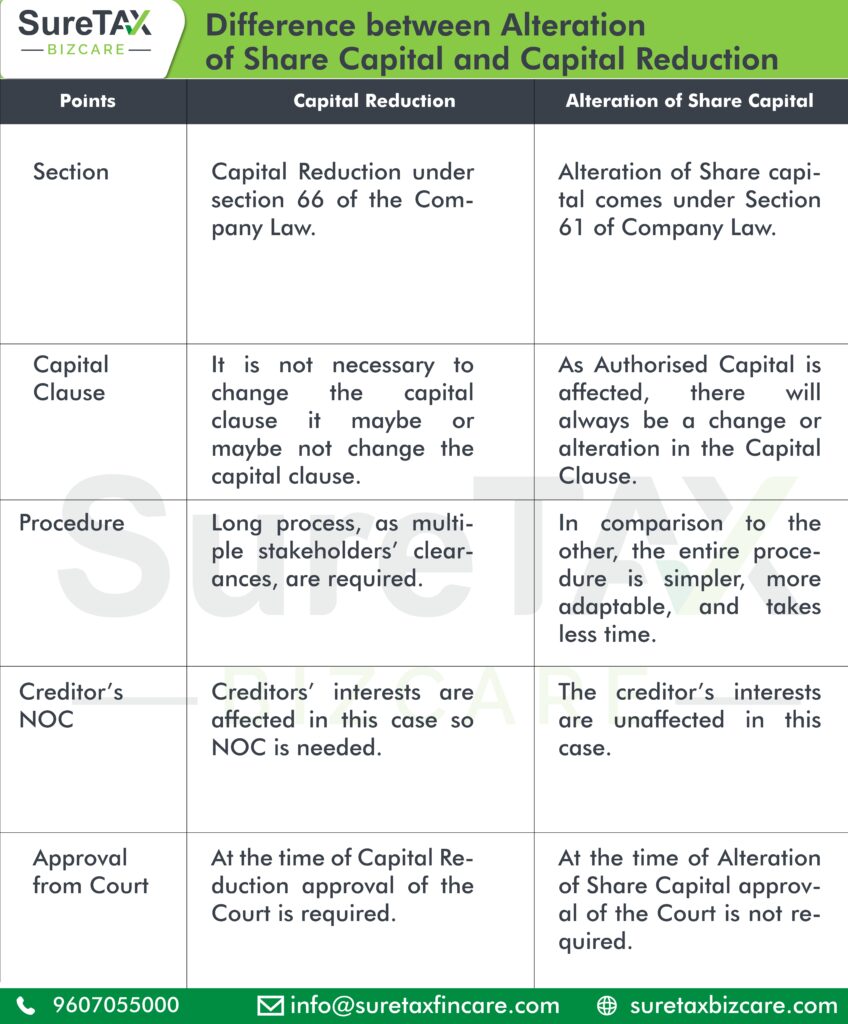
Difference between Alteration of Share Capital and Capital Reduction

Different kinds of Alteration of Share Capital

Sub Division of Shares

A company’s share capital can also be modified by subdividing the nominal value of the shares held by its shareholders.

To Increase an Authorized Capital

Authorized capital, also known as registered or nominal capital, represents the maximum amount of share capital that a company is legally permitted to issue to its shareholders. It is not the amount of money needed to start a business, but rather the ceiling for the company’s share issuance as stated in its Memorandum of Association.

Conversion of Shares into Stock

A company has the option to alter its share capital by converting its fully paid-up shares into “stock.” “Stock” in this context refers to the consolidated value of fully paid-up shares, rather than individually numbered shares.

Consolidation of Shares

Public access of the companies details on the MCA portal, makes company transparent and reliable for fund raising

Canceling the unissued Shares

A corporation has the ability to cancel outstanding debt, but this action does not lead to a change in its share capital.